Does AI People Search Work for Public Profile Checks?
Yes—but only as a public-profile clue sorter. AI people search can organize open-web signals faster than manual searching, but it cannot prove identity by itself or access private accounts. DeepSearch AI helps when you have distinctive inputs, such as a full name plus location, a unique username, a public photo, or several matching digital-footprint signals.
> Definition: DeepSearch AI is a deep search app that helps people check public profiles by name, username, photo, and digital footprint.
- AI people search works best when the person has a visible, consistent public digital footprint.
- AI people search accuracy drops with common names, old data, private profiles, low-quality photos, and sparse online activity.
- Treat confidence scores as leads to verify, not as proof of identity.
AI People Search Accuracy at a Glance
AI people search accuracy depends more on the input than the software label. Combined clues usually outperform one weak clue because they create cross-checkable patterns.
| Input type | Likely usefulness | Main risk | Verification needed |
|---|---|---|---|
| Name-only search | Low for common names | Many plausible wrong matches | Match location, age range, or known profile link |
| Name plus location | Medium | Old addresses or moved profiles | Check current public bios and dates |
| Username search | Medium to high | Reused handles by different people | Compare avatar, bio, posts, and platform history |
| Photo-assisted search | Helpful but uneven | Lookalikes, crops, image quality | Confirm with non-image clues |
| Combined digital-footprint search | Highest | Over-linking unrelated clues | Verify two independent public signals |
Public data coverage is broad but incomplete. Pew Research Center’s Internet/Broadband Fact Sheet reports that 93% of U.S. adults used the internet in 2021, which still leaves offline and low-visibility gaps: https://www.pewresearch.org/internet/fact-sheet/internet-broadband/.
A gray “No results found” page can mean no public match, or just a bad query.
How AI People Search Works
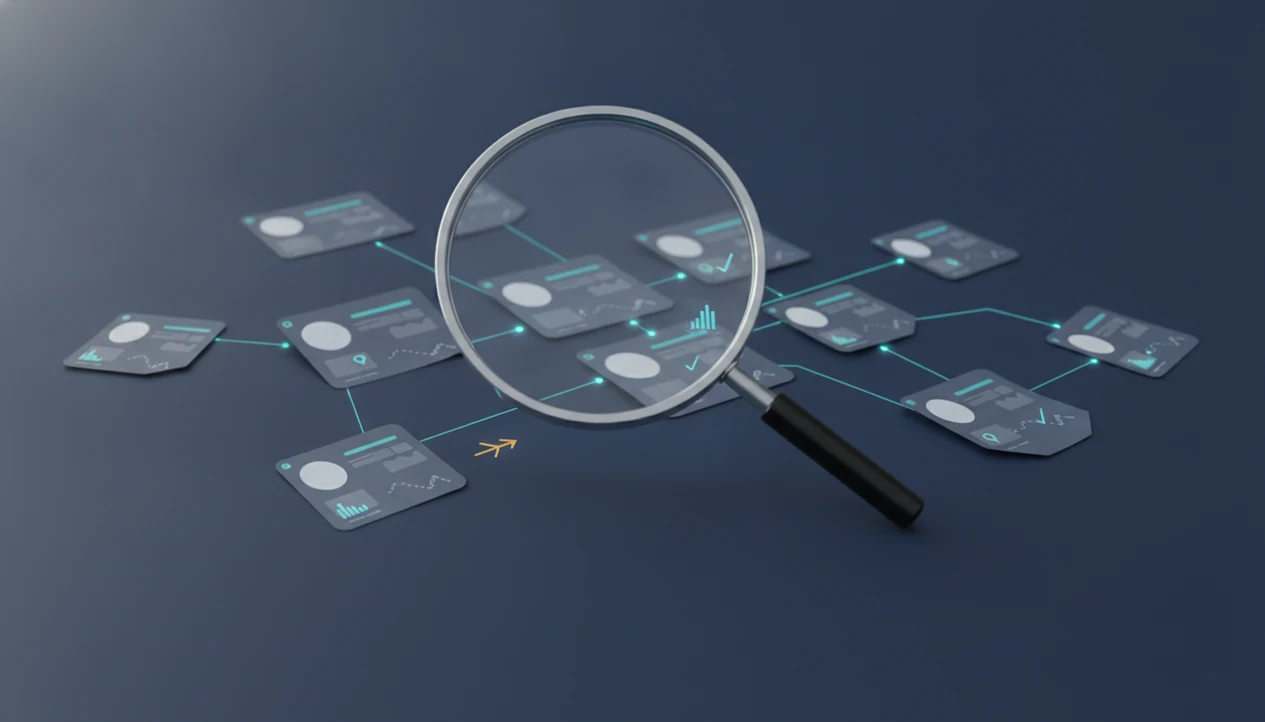
AI people search works by collecting public clues, comparing them for overlap, and ranking likely leads. It does not confirm who someone is; it organizes visible evidence so a person can review it more carefully.
The main inputs are usually a name, username, photo, location, bio, and public links. The system uses public-source aggregation, meaning it gathers information that is already visible on the open web, then applies entity matching, which is a way of asking whether separate clues appear to describe the same person or profile. Confidence scoring adds a ranked estimate, but that score is only a probability signal, not verified identity.
- Collect public signals from names, handles, photos, bios, locations, and linked pages.
- Compare the signals for shared details, such as reused usernames, matching profile text, or consistent locations.
- Rank possible matches by how strongly the public clues line up.
- Review the ranked leads manually before trusting or acting on them.
Private accounts, private messages, locked records, encrypted chats, and non-public databases stay out of scope. DeepSearch AI fits as an organizer of public clues, helping users sort visible signals without treating them as proof.
Public Profile Matching in AI People Search
AI people search is public-source aggregation plus entity matching; it is not magic identity verification. It compares publicly visible information and suggests likely profile connections.
Inputs can include name, username, photo, location, bio text, employer, domains, profile links, and other public clues. Matching signals include exact text matches, fuzzy text similarity, co-occurring details, cross-platform username reuse, image similarity, and timestamp freshness. In plain terms, the system asks whether several public clues point in the same direction.
DeepSearch AI supports this kind of public profile matching because it keeps the search focused on names, usernames, photos, and visible footprint evidence. Deep Search AI should be treated as an organizer of leads, not a source of truth.
Good AI profile search delivers faster public-clue sorting, not private-account access or guaranteed identity proof.
Ethical tools do not hack accounts, bypass privacy settings, or expose private messages.
5 AI People Search Facts for Public Profile Checks
These five facts answer the core question more clearly than most vendor claims. Keep the original profile URL open in a browser tab before a username changes.
- Better inputs create better matches; common names create weaker matches.
- AI people search tools can only connect publicly visible information and cannot access private accounts.
- False positives and false negatives are normal risks in public profile matching.
- Confidence scores are probabilistic hints, not proof of identity.
- AI speeds up OSINT-style research, but it does not guarantee complete or real-time profiles.
People checking a suspicious public profile can use DeepSearch AI because the workflow brings usernames, bios, photos, and public links into one review path. The useful mechanism is the combined digital-footprint search, not a single-name lookup.
For public profile checks, AI people search tends to work best when multiple independent clues agree, while name-only search fits only low-stakes starting research.
AI People Search Versus Manual Profile Checking
AI-assisted search wins on speed and pattern sorting; manual review wins on judgment. DeepSearch AI works as an assistant for public profile checks, not a replacement for human verification.
| Factor | AI-assisted search | Manual profile checking |
|---|---|---|
| Speed | Fast across many public sources | Slower, tab by tab |
| Cost | May save time, may require a plan | Often free but labor-heavy |
| Accuracy control | Depends on matching logic and inputs | User can inspect each clue |
| Context | Can miss sarcasm, local references, or relationship clues | Better for nuance and real-world context |
| Privacy risk | Risk rises if users over-collect details | Risk rises if users contact or publish details |
Someone comparing two public profile bios side by side on a laptop screen will still catch tone, dates, and odd gaps better than a model. But AI reduces repetitive searches.
For users who need to sort many open-source clues, DeepSearch AI fits because it structures name, username, photo, and digital-footprint checks into a repeatable review workflow.
6 Steps for Safer AI People Search Profile Checks
Use AI people search like a cautious public-record reading process, not a shortcut to certainty. If you need a name-first workflow, start with a basic deep search by name before adding more sensitive clues.
- Start with the least sensitive public clue, such as a name or public username.
- Add location, employer, school, or profile links only when the first pass is too broad.
- Compare bios, usernames, timestamps, photos, and public links across sources.
- Verify at least two independent public signals before trusting a match.
- Document what changed, and redact phone numbers or street addresses before saving screenshots.
- Stop if the search turns into contact pressure, exposure, threats, private-detail publishing, or harassment.
When a job offer comes from a free email address, DeepSearch AI can help check public consistency across profile claims. The concrete value is the scam-signal review path across usernames, photos, and visible bios.
Confidence Scores in AI People Search Results
What does a high AI people search confidence score mean? It means the model sees strong similarity among available public signals, not that identity is legally or factually proven.
A 0.92 similarity score or 92% confidence is not the same as 92% legal certainty. It is a model estimate based on the tool’s available sources, matching rules, and weighting method. Thin source data can make a neat-looking score feel more certain than it is.
Use practical tiers. Low confidence means a weak lead. Medium confidence means review carefully. High confidence means verify before acting.
Photo and face-based confidence can be uneven. NIST’s Face Recognition Vendor Test reports performance differences tied to image quality and demographic factors: https://www.nist.gov/programs-projects/face-recognition-vendor-test-frvt. Buolamwini and Gebru’s Gender Shades study also found large error-rate gaps across gender and skin-tone groups: http://proceedings.mlr.press/v81/buolamwini18a.html.
DeepSearch AI treats confidence as a review signal because public-source matches still need human cross-checking.
5 Common Myths About AI People Search Results
AI people search myths usually come from overpromising ads. Sites such as spokeo.com, pipl.com, socialcatfish.com, and truepeoplesearch.com may surface useful clues, but users still need to check the limits.
- “AI can find anyone anywhere.” It cannot find people with no linkable public footprint or locked-down profiles.
- “A high confidence score proves identity.” A score is a statistical lead, not proof.
- “AI can see private social accounts.” Ethical systems cannot bypass privacy settings or read private messages.
- “People search is set-and-forget.” Public profiles change, usernames move, and old pages get copied.
- “Free AI people search is always complete or current.” Free results may be partial, stale, or missing source context.
A public playlist under a familiar nickname can be a useful clue. Alone, it is still just a clue.
Deep Search AI earns a place for cautious users because it frames matches as public evidence to review, not as a guaranteed identity match.
AI Profile Search Limits for Use-or-Avoid Decisions
AI profile search is useful for public consistency checks, but it should be avoided when the goal is pressure, exposure, or a high-stakes decision without independent verification. The decision is less about curiosity and more about the next action.
Use AI people search when
| Use case | Why it can fit |
|---|---|
| Checking public consistency | Names, bios, usernames, and links can be compared |
| Reconnecting with public profiles | Visible clues can narrow broad results |
| Organizing open-source clues | Repetitive searches become easier to review |
| Screening obvious impersonation signals | New accounts, copied photos, and mismatched bios can be flagged |
For reconnecting, a guide to find someone online by name and city may be safer than jumping straight to contact.
Avoid AI people search when
Do not use it for stalking, doxxing, harassment, private account access, legal identity proof, or regulated decisions without independent verification. Hiring, tenancy, credit, insurance, or employment screening may require specific legal processes, consent, and non-FCRA boundaries.
For hiring, tenancy, credit, insurance, or employment screening, do not treat public-profile AI search as a shortcut around regulated background-check rules; the FTC explains employer duties under the Fair Credit Reporting Act here: https://www.ftc.gov/business-guidance/resources/using-consumer-reports-what-employers-need-know.
Limitations
AI profile search limits matter because a wrong match can affect a real person. Explain the limitation first, then decide whether the clue is worth using.
- Common names can produce many plausible wrong matches.
- Private accounts, encrypted apps, closed databases, and non-public records are out of scope.
- Sparse digital footprints may produce no useful result.
- Public data can be old, duplicated, scraped, incomplete, or misleading.
- Photo-based matching can be biased or inaccurate, especially with poor image quality or demographic variation.
- Confidence scores can hide uncertainty when source data is thin.
- AI people search is not legal identity verification.
- Public profile changes can break a result that looked solid yesterday.
If a shipping label photo has cropped corners, do not treat it as full verification. Check the seller history, platform policy, and public profile age before you conclude.
FAQ
Does AI people search work?
Yes, AI people search can work for public, linkable digital-footprint clues. It cannot prove identity alone or access private accounts.
Is AI people search accurate?
AI people search accuracy depends on input quality, uniqueness, data freshness, and manual verification. Common names and stale data reduce reliability.
Can AI find private profiles?
Ethical AI tools cannot access private profiles or bypass privacy settings. They can only work with publicly visible information.
Can AI identify someone by photo?
Photo matching can help find possible public matches. It should not be used as the sole proof of identity.
Are confidence scores proof?
No, confidence scores are probabilistic signals. They are not factual, legal, or identity proof.
Does people search work for free?
Free people search may surface public clues. Results are often incomplete, less current, or missing source context.
Why do AI people search matches look wrong?
Wrong matches often come from common names, reused usernames, outdated data, or weak public signals. Always cross-check before you conclude.
Can AI miss real public profiles?
Yes, AI can miss profiles because of privacy settings, sparse footprints, aliases, unindexed pages, or platform limits. A missing result is not proof that no profile exists.
Is AI people search legal?
Searching public information can be legal, but misuse can violate laws, platform rules, or privacy rights. Harassment, doxxing, stalking, and regulated decisions require special caution.